Address
Ponzi Vineyards, Southwest Mountain Home Road, Sherwood, Oregon, USA
Phone
Hours
Closed for today
-
Monday
10:00am – 5:00pm
-
Tuesday
10:00am – 5:00pm
-
Wednesday
10:00am – 5:00pm
-
Thursday
10:00am – 6:00pm
-
Friday
10:00am – 6:00pm
-
Saturday
10:00am – 6:00pm
-
Sunday
10:00am – 6:00pm
Reservations
Yes
Address
Ponzi Vineyards, Southwest Mountain Home Road, Sherwood, Oregon, USA
Phone
Hours
Closed for today
- Monday 10:00am – 5:00pm
- Tuesday 10:00am – 5:00pm
- Wednesday 10:00am – 5:00pm
- Thursday 10:00am – 6:00pm
- Friday 10:00am – 6:00pm
- Saturday 10:00am – 6:00pm
- Sunday 10:00am – 6:00pm
Reservations
Yes
Dick Ponzi was a structural engineer — aerospace, rockets, fighter jets, an early Ford Mustang project, and later rides for Disney. He was the third son of Italian immigrants who bought California grapes every year and made wine as a community. A trip to Europe and a bottle of Burgundy changed the plan. He’d also come to oppose the Vietnam War and the work that went with it.
In 1969 he and Nancy drove north from Los Gatos in a flatbed truck carrying two cats, a dog, a canoe, a piano, and four barrels of homemade wine. They bought 20 acres southwest of Portland — close to the city because they expected it to be their market. There were four other wineries in Oregon at the time, and the main crops were hazelnuts, cherries, apples, and hay. They founded Ponzi Vineyards in 1970 and made their first four barrels in 1974.
They planted ungrafted, because nobody told them grafting was standard. Early Chardonnay was a disaster — the UC Davis clonal material was bred for California heat, not a marginal cool climate. Dick’s cold-soak technique, developed here, was later adopted across the valley and in Burgundy. Robert Parker named him among the world’s best winemakers in 1988, and in 1985 compared Ponzi wines to Domaine de la Romanée-Conti. He was the founding president of the Oregon Winegrowers Association. He and Nancy also founded BridgePort, Oregon’s first craft brewery.
Luisa Ponzi went to Beaune and became the first non-French woman to earn the Certificate Brevet Professionnel d’Oenologie et Viticulture. She came home in 1993 as the winery’s second-ever winemaker, fixed the Chardonnay problem, pioneered the clonal massale technique at Avellana — twenty-plus Pinot clones planted randomly in one block and harvested together — and led the petition for the Laurelwood District AVA, approved in 2020 as Oregon’s first appellation defined by soil type rather than geography.
In 2021 Groupe Bollinger, the family behind Champagne Bollinger since 1829, bought Ponzi — their first property outside France. Luisa stayed on. In 2024 she passed the winemaking title to Max Bruening, only the third person to hold it in 54 years and the first outside the family.
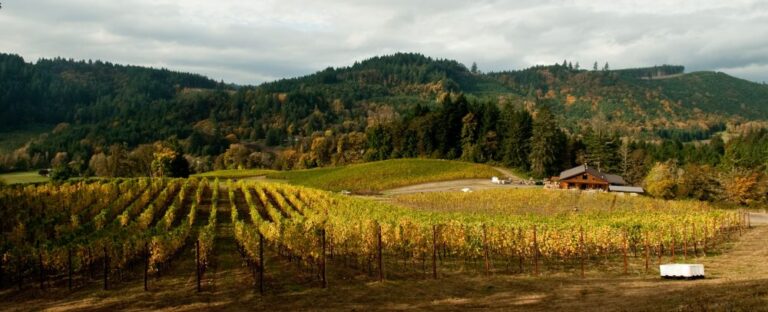
The estate farms roughly 150 acres almost entirely within the Laurelwood District, wind-blown loess over basalt. Key sites include Abetina, planted 1975, Madrona from 1985, Aurora from 1991, and Avellana from 2006. Own-rooted old vines, gravity-flow winemaking, native yeasts, CCOF Certified Organic and LIVE certified. Around 30,000 cases a year.
Groupe Bollinger, since 2021. The Ponzi family retained most of the vineyard acreage and sells fruit back under long-term contract.
Common questions
Do I need a reservation?
How far from Portland?
What should I taste?
What’s Laurelwood soil?
Is it expensive?
Is there food?
Who owns it now?